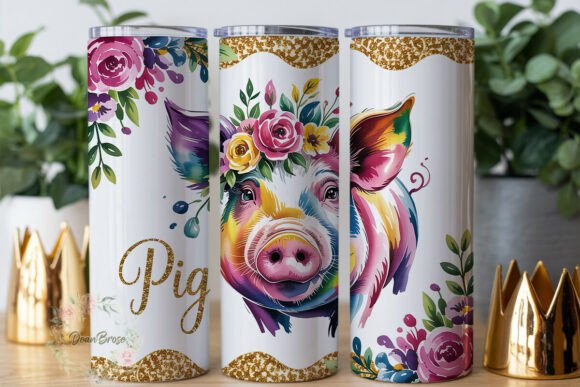
Review: Watercolor Pig Floral 20oz Tumbler Wrap Design
As a designer who spends more time staring at stitch maps than most people care to admit, I approach every new machine embroidery design with a mix of curiosity and skepticism. We have all been there: you buy a beautiful digital embroidery file, load it onto your machine, and realize halfway through that the density is wrong for the fabric or the details are too fine to survive a wash cycle. That is why I took a close look at the Watercolor Pig Floral 20oz Tumbler Wrap. While this product is marketed primarily as a graphic for sublimation or printing on tumblers, my job is to evaluate its potential beyond the screen. Can this aesthetic translate into a tangible, stitched handmade product? Let's dig into the practical realities of using this asset in a real-world craft business.
First Impressions: Mood and Visual Personality
The first thing that strikes me about the Watercolor Pig Floral 20oz Tumbler Wrap is its gentle, whimsical mood. The watercolor style suggests softness, which is a delightful departure from the rigid, vector-heavy graphics we often see in the Tumbler Wraps category. The layout features a charming pig surrounded by floral elements, creating a narrative that feels perfect for nursery decor, baby gifts, or boutique branding for children's apparel. The dimensions provided—9.3″ x 8.2″—indicate a large-scale image intended to wrap around a cylinder. For an embroiderer, this scale is significant. It implies a design with substantial coverage, likely requiring careful management of stitch density to prevent the fabric from puckering or becoming stiff like cardboard.
The visual personality here is undeniably cute but sophisticated enough for modern trends. It avoids being overly cartoonish, leaning instead into that popular "farmhouse chic" aesthetic that sells well on Etsy. If you are an Etsy seller looking to expand your line of custom apparel or home goods, this theme hits a sweet spot. However, because the source files are high-resolution PNGs (300 DPI) rather than native embroidery formats, the translation from pixel to thread requires a strategic eye.
Real-World Application: From Screen to Stitch
Let's imagine a realistic scenario. You run a small shop specializing in personalized baby items and holiday gifts. A client requests a custom sweatshirt embroidery project for a newborn's coming-home outfit, featuring a pig theme. The Watercolor Pig Floral 20oz Tumbler Wrap serves as the perfect inspiration or base layer for this project. Since the purchase includes PNG files for both straight and tapered tumblers, you have flexibility in how the image curves. In an embroidery context, you would likely need to digitize this image yourself or hire a digitizer to convert those soft watercolor gradients into actionable satin stitch, fill stitch, or running stitch commands.
This design shines when applied to larger canvases. Think about a heavy canvas tote bag design or a structured embroidered patch. The floral elements surrounding the pig offer excellent opportunities for creative thread work. You could use variegated threads to mimic the watercolor effect, adding depth that a flat print cannot achieve. For a holiday embroidery collection, perhaps for Easter or a farm-themed birthday party, this graphic could be scaled down to fit on aprons or kitchen towels. The key is recognizing that while the original intent is a tumbler wrap, the composition works beautifully on flat surfaces where the "wrap" aspect becomes a panoramic scene.
Navigating Technical Challenges
However, we must be realistic about the limitations. Taking a graphic designed for a smooth, hard surface like a tumbler and adapting it for textured fabrics requires caution. If you attempt to stitch this on a stretchy fabric like a thin t-shirt without proper stabilization, the large fill areas typical of watercolor styles can cause distortion. The fabric texture plays a huge role here. On a fluffy towel or a knit sweatshirt, tiny details might get lost. I strongly advise testing the design on scrap fabric first. Check how the thread colors contrast against your chosen material; a light watercolor pig might disappear on a dark navy hoodie unless you plan for an underlay or a backing patch.
Furthermore, consider the hoop size. The original dimensions are quite large (over 9 inches wide). Not every home embroidery machine can handle a hoop of that magnitude in one go. You may need to split the design into sections or reduce the scale significantly. If you are working on curved surfaces like caps, the wide layout of the Watercolor Pig Floral 20oz Tumbler Wrap will not work without major modification. Caps require tall, narrow designs. Trying to force this wide graphic onto a cap front would result in cropping the essential floral details, ruining the composition.
Enhancing Product Value and Brand Consistency
Why go through the trouble of adapting a graphic file for embroidery? Because the finished product carries a perceived value that prints often lack. An embroidered item signals quality, durability, and human effort. When a customer receives a personalized gift featuring this pig and floral motif stitched in high-quality thread, it builds trust in your brand. It elevates a simple small shop product into a heirloom-quality item. For commercial embroidery projects, consistency is key. Using a cohesive set of assets like this helps maintain brand recognition across different items, from tote bags to pillow covers.
The "watercolor" look, when executed well in thread, adds a painterly touch that appeals to buyers looking for something unique. It differentiates your finished product from the mass-produced items found in big-box stores. This distinctiveness drives buyer engagement and allows you to command a higher price point. Whether you are creating printable mockups for your online store or showcasing actual samples at a craft fair, the tactile nature of embroidery combined with this charming artwork creates a powerful sales tool.
Designer Notes and Best Practices
Before you commit to producing a full line of goods based on the Watercolor Pig Floral 20oz Tumbler Wrap, keep these practical tips in mind:
- Check Licensing: The product description notes that watermarks are removed upon download, but always confirm the specific license terms regarding commercial use for physical goods versus digital resale.
- Digitization Strategy: Since you are receiving PNG files, remember that these are images, not embroidery files. You will need to digitize them. Pay close attention to stitch direction in the floral areas to ensure they flow naturally.
- Stabilizer Selection: For a design of this size and potential density, use a cut-away stabilizer for knits and a tear-away for wovens. Do not skimp here; the weight of the stitches needs support.
- Color Testing: Test your thread palette against both light and dark backgrounds. What looks vibrant on a white tumbler might look muddy on a heather grey sweatshirt.
- Detail Inspection: Zoom in on the pig's facial features and the flower centers. If these areas are too small, simplify them. Tiny lettering or micro-details often turn into thread blobs after washing.
In conclusion, the Watercolor Pig Floral 20oz Tumbler Wrap is a versatile asset that extends far beyond its intended use on drinkware. With thoughtful adaptation and skilled digitizing, it can become the centerpiece of a lucrative line of baby embroidery, boutique apparel, and home decor. It offers the charm and detail that modern consumers crave, provided you respect the technical constraints of the medium. As always, let your creativity lead, but let practical testing guide your production.