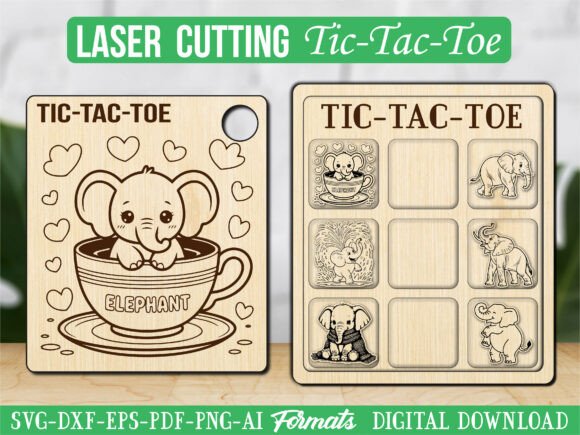
Review: Elephant on Cup Tic Tac Toe Puzzle Game
As a designer who spends more time staring at stitch simulations than actual sunlight, I approach every new machine embroidery design with a healthy dose of skepticism. We have all been there: you download a cute file, load it onto your machine, and halfway through the run, you realize the density is going to turn your soft cotton into cardboard. That is why I took a close look at the Elephant on Cup Tic Tac Toe Puzzle Game. While the product listing categorizes this under Laser Engraving and Graphics, my job is to translate that visual concept into thread. Can this playful graphic survive the transition from a vector path to a stitched reality? Let's dig into the practicalities.
First Impressions: Mood and Layout
The first thing that strikes me about the Elephant on Cup Tic Tac Toe Puzzle Game is its inherent charm. There is a whimsical quality to combining an elephant—a symbol often associated with memory and wisdom—with the simplicity of a tic-tac-toe grid inside a cup. It creates a narrative immediately. This isn't just a random shape; it suggests playfulness, nostalgia, and perhaps a morning coffee routine turned into a game.
Visually, the layout feels balanced. The circular or cup-shaped boundary provides a natural frame, which is excellent for embroidery because it mimics the shape of standard hoops. For a craft business owner, this means less wasted space on your garment and a cleaner finished look. The theme leans heavily into nursery decor or casual lifestyle branding, making it a strong contender for baby showers, teacher gifts, or boutique café merchandise. However, the devil is always in the details, specifically how those details translate to thread.
Real-World Application Scenarios
I recently had a client request a series of personalized items for a local daycare's end-of-year gifts. They wanted something unique but durable. This is exactly where a design like the Elephant on Cup Tic Tac Toe Puzzle Game shines. Imagine this stitched onto a canvas tote bag design. The sturdy fabric can handle the necessary stitch density required to make the elephant's features pop without puckering.
Another viable avenue is sweatshirt embroidery. A heather grey crewneck with this design in navy and white thread would look incredibly professional. Because the concept involves a "game," it invites interaction. You could even embroider the X's and O's in contrasting colors to make them stand out against the cup background. For Etsy sellers looking to expand beyond standard monograms, this offers a narrative element that increases perceived value. It transforms a basic hoodie into a conversation piece.
I also see potential for embroidered patch production. If you digitize this with a merrowed edge or a satin stitch border, it becomes a versatile accessory that customers can iron onto jackets or backpacks. This extends the life of the digital embroidery file beyond a single garment, allowing you to sell the physical patch as a standalone small shop product.
Technical Considerations for Stitching
Here is where we need to be realistic. The original asset is described as a laser cut file. Laser cutters thrive on continuous vectors and sharp corners. Embroidery machines, however, deal with thread tension and fabric pull. If you are adapting this Graphics file for embroidery, you must pay close attention to the tiny elements.
The tic-tac-toe grid lines, if too thin, will vanish under satin stitch or look jagged with a running stitch. You may need to thicken these lines in your digitizing software to ensure they remain visible after washing. Similarly, the elephant's facial features—eyes, trunk details—need to be large enough to prevent thread breaks or bird-nesting.
Fabric choice is critical. On textured fabrics like waffle weave or heavy terrycloth, fine details can get lost. I recommend testing this on a smooth, medium-weight cotton or a stable polyester blend first. If you attempt this on stretchy jersey knits without a high-quality cut-away stabilizer, the grid lines will likely distort, ruining the geometric precision of the game board. Furthermore, curved surfaces like caps require careful positioning; the center of the cup design must align perfectly with the cap's seam to avoid visual distortion.
Color and Contrast Strategy
Visual appeal relies heavily on your thread colors. Since this is a "cup" design, using a light beige or white for the cup body with a darker outline creates a classic ceramic look. The elephant should contrast sharply—perhaps a slate blue or charcoal grey. Avoid low-contrast combinations like light yellow on white, as the fill stitch areas will blend together, making the design look muddy from a distance. Always view your design in black and white mockups before stitching to check for value contrast.
Commercial Viability and Branding
For commercial embroidery projects, consistency is key. The Elephant on Cup Tic Tac Toe Puzzle Game has a friendly, approachable vibe that builds customer trust. It signals that your brand pays attention to fun details. Whether used for holiday embroidery gifts or year-round boutique branding, the design feels intentional rather than generic.
However, you must verify the licensing terms. Just because a file is available for download does not automatically grant commercial rights. Before selling finished products or including this in a bundle of design assets, confirm whether the creator allows for commercial use of the adapted embroidery version. Protecting your craft business from legal issues is just as important as the stitch quality.
Final Verdict and Designer Notes
In conclusion, the Elephant on Cup Tic Tac Toe Puzzle Game is a promising concept for embroidery, provided it is adapted with care. It moves beyond simple decoration to tell a story, which is what drives sales in the handmade market.
Before committing to a production run, follow these practical steps:
- Test on scrap fabric: Never run a new design on a final garment without a trial.
- Check hoop size: Ensure the design fits within your available hoop dimensions without needing excessive re-hooping.
- Review stitch density: High density can cause stiffness; adjust pull compensation if necessary.
- Inspect small details: Zoom in on the tic-tac-toe lines to ensure they are wide enough for thread.
- Compare backgrounds: Test how the design looks on both light and dark fabrics to determine if an underlay is needed.
By treating this graphic not just as an image but as a structural challenge, you can create a finished product that delights customers and stands up to the rigors of daily wear. It is a perfect example of how a simple idea, when executed with technical precision, becomes a valuable addition to your portfolio.